Tuesday, January 28, 2014
IRB Intro Cheddi Jagan Forbidden Freedom: The Story of British Guyana
First published in 1954 this autobiography of the late leader of Guyana, Cheddi Jagan, recounts the turmoil that his home country faced. During this time period Guyana was beginning to branch out from being a colony of Britain to being a whole other country that could govern themselves. The book goes though the time period where Cheddi Jagan was legally elected but then kicked out of power so that Britain and America could further their anti-communism agenda even though there was no solid bond between Cheddi Jagan and the Communist nations. It also tracks all the time between the oppressive Burnham years and to when Cheddi Jagan was finally elected into power and as able to maintain power without any foreign conflict. The author of this book wants to try and tell his audience what was happening from his point of view so that they understood what he was facing. My great grandfather was a participator in the Cheddi Jagan movement. So in order to learn more about my family and why they left from their home country I am reading this book to clear up some of my preconceived notions. I normally do not read autobiographies unless they are for a project, so this book is a stretch for my library of books.

Friday, January 17, 2014
TOW 16 MLK Day By: Joe Heller
In this cartoon it has a calendar of the month of January. On it has Dr. Martin Luther King Jr. Day written on the January 20th, however on all the other days of the calendar there is an acronym on them stating "MLKD" meaning "Must Live King's Dream." Joe Heller is the artist for this piece. He is an artist who paints for the Green-Bay Press gazette. Dr. Martin Luther King Jr. Day is a day of service. A day where people go out and help their community in any way possible that they can go out and help them. A day where people who do not normally go out and do service can go out do a little bit of service to the people around them. Therefore, when the author puts "MLKD" on the rest of the days of January it is saying that we all need to go out into the community and try and help it everyday of our lives. He is addressing the masses when he created this cartoon. He wanted people who normally do not help their community to get up and go to help people. By creating the cartoon near Dr. Martin Luther King Jr. Day it may cause some people to get up and go out. They might be motivated when they see this cartoon to act and help their community out. I thought that this piece was very effective. It used the idea that we all have to give service once everyday and was able to portray in perfectly by using the calendar and the different acronyms. Having the publication near Dr. Martin Luther King Jr. Day is also very helpful because now I feel as though I need to go out this year and help out my community.

Sunday, January 12, 2014
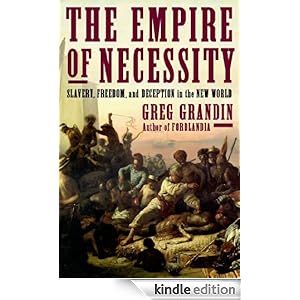
Tow #15 A Vengeful Fury Greg Grandin’s ‘Empire of Necessity’ By: Andrew Delbanco
A powerful new book has been released by Greg Grandin about slavery. In his book he talks about how there were many people who lost their lives to slavery and how it fueled the growth and power of Europe. The author of the book goes into a lot of detail when describing the conditions and what the slaves had to do. Grandin also does a very good job at passing through years of time. The author skips from time period to time period in order to fit the scope of his book. This is detectable and might bother some people. However it is a seamless transition from time period to time period. Another way that the author of the book is able to portray the tragedies of slavery is through short stories that he has found. The author does elaborate on some parts of the history, but he does keep with his theme of the tragedies of slavery. One such story is the one of two New England farmers who would have never been in contact with slaves if it had not been one who ran away telling them of their pains and sorrows as a slave. The author of this review is Andrew Delbanco, the director of American studies in Columbia University. He wrote this review in order for the average person to understand this complex and deep book. He wanted the people who read the New York Times to go and read a book that hey might not have picked up to read. By portraying the book as an intellectually challenging and interesting book the author of this review does accomplish his purpose of getting other people to read this book.
Wednesday, January 1, 2014
TOW #14 Bulbageddon is upon us By: Ry Crist
With the New
Year comes many changes to our daily lives. One of those changes will be the
new standard in energy efficient light bulbs. Ry Crist, the associate editor at
CNET explains that with the addition of a new light bulb to the light bulb
market adds a new energy efficient light bulb. The author explains that with
this new addition to the light bulb market the incandescent light bulb will
become more of a thing of the past. He however states that if you are in
desperate need of an incandescent light bulb shops will still have them because
they will have to try and sell out all of their stock. The author wrote this
piece so he could tell the masses not to worry about their favorite light bulb.
He also wanted them to know that with the end of the incandescent light bulb
will bring on a new age of energy efficiency. By telling a large amount of
people about the changing market of light bulbs there will be a small
percentage of people who will not know why there are less incandescent light bulbs
than there are energy efficient. For people who really want the same
incandescent light the author provides an energy efficient light bulb that will
give off the same amount of light as an incandescent light bulb at a fraction
of the wattage. Ry Crist also explains to the audience that not many people
know if they have incandescent light bulbs or not. He says that 4 out of every
10 Americans do not know if they have incandescent light bulbs or not. By
establishing this point people who read this article will go and check to see
whether or not they have incandescent light bulbs making those people change
their light bulbs or making those people go out and buy incandescent light bulbs. I believe that the article was able to accomplish its purpose of expanding the views of the public on the lightbulb market.

Subscribe to:
Comments (Atom)