Dear New APELC Student,
I hope you are ready for an interesting class. This class is not like your other classes. Expect to get really bad grades on your first few essays. Mr. Yost is grading you on the AP scale, and will be until the end of class. Expect to be disappointed with your test scores, you are going to see some grades and not like them at all. They will be C's and D's all throughout the class. However, if you play your cards right you can make it in the class by getting a B in the overall class.
What worked for me in the class is to pay attention. This seems like a no brainer, but it is very important and I can not stress it enough. The things that Mr. Yost go over in class are going to be on the tests that he gives you. You will not have to think abstractly in the class. All the knowledge that you need in the class is to think like the AP graders and then right an essay in which fits the rubric. There is nothing to it, except that it is extremely hard to pull off successfully.
What did not work for me in class is not being a part in the class discussion. It is imperative that you be a part of the class discussion. That is the only solid way that Mr. Yost knows that you are paying attention in class. He hands out worksheets and has projects to see if you know what you are doing, but asking questions and answering his questions are the best. If you afraid of being wrong in his class, don't be because you are in school to learn and being wrong is okay.
I think something that I would have liked to hear in the beginning of the class would be that this class will can be fun. I went into this class thinking that it would be really hard and that you would just be dragging through the mud trying to finish the class. During the Plato part of the year, it is pretty fun and during the year there are some times where I enjoyed being in the class.
The class is hard, but fun.
Sincerely,
An old APELC student
Tuesday, June 3, 2014

Sunday, June 1, 2014
TOW 29 Good ol Freda
In the documentary one of the ideas is that Freda Kelly was an important person to the popularity of The Beatles. A main focus of the movie it elaborates in many ways. Kelly is a quiet character in The Beatles's history. One who has stuck to the shadows and has been someone who has helped from afar. Through here persistence and maintaining the fan club and at working on the magazine that was sent out every month kelly was the unsung hero that has finally reached the spotlight after many years.
One main aspect of improving The Beatles popularity was the constant work in The Beatles fan club. Freda Kelly was the secretary for the club and she made it her job that all the little girls and the boys would get letters back saying that The Beatles had received it. The club was always on top of their job and Freda kelly was said to have run quite an operation among her workers. Kelly would even take home letters to her apartment to work on them. She was dedicated and hardworking. Allowing The Beatles rise to fame smooth.
Another thing that Kelly did that was extremely helpful and revolutionary to the music world was that kelly had created a Beatles magazine. This was a magazine that held the most up to date things on everything Beatles. It was a new way that artists could get in touch with their fans. Kelly invented this new mode of interaction and kept up with it all the way until The Beatles dissolved.
A major player in the growth of the most important band in the world. Freda Kelly was the secretary the helped propel The Beatles into golden status.
One main aspect of improving The Beatles popularity was the constant work in The Beatles fan club. Freda Kelly was the secretary for the club and she made it her job that all the little girls and the boys would get letters back saying that The Beatles had received it. The club was always on top of their job and Freda kelly was said to have run quite an operation among her workers. Kelly would even take home letters to her apartment to work on them. She was dedicated and hardworking. Allowing The Beatles rise to fame smooth.
Another thing that Kelly did that was extremely helpful and revolutionary to the music world was that kelly had created a Beatles magazine. This was a magazine that held the most up to date things on everything Beatles. It was a new way that artists could get in touch with their fans. Kelly invented this new mode of interaction and kept up with it all the way until The Beatles dissolved.
A major player in the growth of the most important band in the world. Freda Kelly was the secretary the helped propel The Beatles into golden status.
Monday, May 26, 2014
TOW #28 Good Ol' Freda
This documentary was about the secretary of The Beatles. Her name was Freda Kelly and she is still alive. This documentary tracks her life from the beginning of The Beatles to the current day. The main speaker in this documentary is Ms. Kelly. She speaks through the whole documentary explaining every what she was doing in respect to what The Beatles were doing. An example would be when The Beatles went to India, she said that she was there with them. The audience that the documentary is appealing to is The Beatles fan base. It is trying to educate them on someone they might have never known who was vitally important during Beatle-mania.
The documentary was trying to teach its audience about Freda Kelly. A person who has mostly been at the sidelines of The Beatles history, she was very important. The documentary uses pictures and interviews to achieve this idea. There are many pictures in which Freda Kelly is next to The Beatles or she is working with her group of girls on the many fan letters that The Beatles received during their years as a band. In the interviews it has important reporters and workers of Freda Kelly. In the interviews they talk about how Kelly liked to stay to the sidelines and help the band from afar.
Good Ol' Freda also explains how The Beatles rose and fell. In explaining the history and importance of Freda Kelly the documentary also explains the history of The Beatles. The documentary does this by comparing the history of Freda kelly to that of The Beatles. The documentary tells the two stories but has a balance between the two that is unnoticeable.
The final purpose that this movie was made was for Freda Kelly's grandson. At the end of the documentary Freda Kelly explains to the audience that she did not really talk about it a lot with her children when they were growing up and learning about The Beatles. Now Freda Kelly has changed her mind after her son died. Since she feels regret for not going into detail about her life with her son she wants her grandson to have what her son could not. The documentary captures this with the last few scenes as it shows Freda kelly with her grandson as they walk into the sunset,

The documentary was trying to teach its audience about Freda Kelly. A person who has mostly been at the sidelines of The Beatles history, she was very important. The documentary uses pictures and interviews to achieve this idea. There are many pictures in which Freda Kelly is next to The Beatles or she is working with her group of girls on the many fan letters that The Beatles received during their years as a band. In the interviews it has important reporters and workers of Freda Kelly. In the interviews they talk about how Kelly liked to stay to the sidelines and help the band from afar.
Good Ol' Freda also explains how The Beatles rose and fell. In explaining the history and importance of Freda Kelly the documentary also explains the history of The Beatles. The documentary does this by comparing the history of Freda kelly to that of The Beatles. The documentary tells the two stories but has a balance between the two that is unnoticeable.
The final purpose that this movie was made was for Freda Kelly's grandson. At the end of the documentary Freda Kelly explains to the audience that she did not really talk about it a lot with her children when they were growing up and learning about The Beatles. Now Freda Kelly has changed her mind after her son died. Since she feels regret for not going into detail about her life with her son she wants her grandson to have what her son could not. The documentary captures this with the last few scenes as it shows Freda kelly with her grandson as they walk into the sunset,
Tuesday, May 20, 2014
TOW #27 TOW Reflction
This year has been one of growth and new experiences. I believe that from my original TOWs I have changed as a writer for the better.
I feel as though that I have steadily progressed as a writer. I have been able to write with more detail. I am able to get to the point and back up that point with few words. I have been able to keep my TOWs focused and organized. In the first few TOWs that I wrote I would begin very broad and then try to get specific. This however was not always the case as many times I ended up going off course. IN my later TOWs I started specific and moved to broader areas.
I think I have mastered putting the right amount of detail into my TOW. I feel as though I have not overflowed the TOW with quotes and I have also not made it full of just my thoughts in the TOW. I have made the TOWS a mixture of my analysis and quotes or aspects from the certain pieces that I analyzed.
I believe that I still need to improve on my introduction and conclusion. I began with weak introduction and conclusion paragraphs, and have slowly improved them. I still think, however, that they could be a lot better than they are now. They could be a little more broader and the conclusion paragraph could leave the reader with a better thought at the end of the TOW.
I think that my analysis essay greatly improved from this exercise. If it had not been for these TOWs I think that I would have weaker analysis essays. These exercises allowed me time to think and work on the aspects of the analysis essay that I thought needed to be worked on.
I feel as though that I have steadily progressed as a writer. I have been able to write with more detail. I am able to get to the point and back up that point with few words. I have been able to keep my TOWs focused and organized. In the first few TOWs that I wrote I would begin very broad and then try to get specific. This however was not always the case as many times I ended up going off course. IN my later TOWs I started specific and moved to broader areas.
I think I have mastered putting the right amount of detail into my TOW. I feel as though I have not overflowed the TOW with quotes and I have also not made it full of just my thoughts in the TOW. I have made the TOWS a mixture of my analysis and quotes or aspects from the certain pieces that I analyzed.
I believe that I still need to improve on my introduction and conclusion. I began with weak introduction and conclusion paragraphs, and have slowly improved them. I still think, however, that they could be a lot better than they are now. They could be a little more broader and the conclusion paragraph could leave the reader with a better thought at the end of the TOW.
I think that my analysis essay greatly improved from this exercise. If it had not been for these TOWs I think that I would have weaker analysis essays. These exercises allowed me time to think and work on the aspects of the analysis essay that I thought needed to be worked on.
Sunday, May 4, 2014
TOW #26 IRB Post Banker to the Poor By: Muhammad Yunus
My plan for this TOW would be to establish a strong introduction and conclusion. I feel as though that my introductions need work. More specifically the introduction needs to be more general. I would also like my conclusions to be a little bit more specific. I would like the conclusions to have something that would allow the reader to have something to go away with.
Bangladesh has many people stuck in the spiral of poverty, and one man tries to find the way out for them. Muhammad Yunus, an economics teacher and Noble Peace Prize Laureate, wrote his stories in the biography Banker to the Poor. The first seven chapters follow his growth from a little boy in Chittagong to a student at Boulder, Colorado. It also shows how he was an activist for the Bangladesh independence movement, and how he has a desire to see his people out of poverty. The author uses real life examples to show how he has helped the people of Bangladesh.
After the independence of Bangladesh is declared and some of the dust has settled, Yunus moves in to lend some assistance. He goes to a college and applies to be the economics teacher. Through this position he is able to help many of the students get a better education so that they may better the country. Another way that Yunus proves to the reader that he is helping the community is by introducing the idea of microeconomics. The idea first begins with a stool maker he meets when doing a census with some of his students. He asks them how much the stool makers make as profit. When he finds out that they only make about two cents per stool and sell hundreds. They can only afford the raw materials for the next stools and not enough for food. Set on facing this problem head on Yunus gives money directly to the stool makers and not to the person with the raw materials. This introduction of money allowed the stool makers to become economically stable and have better lives for themselves.
This break through idea has not been tested before and in the first seven chapters of the book shock the reader, and allow signs of hope for the people of Bangladesh. This was intended for the mass amount of people. Since many people do not know about the spiral of poverty in most parts of the world Muhammad Yunus introduces this to many people. He does it slowly but also being very detailed in his explanation of what is happening. I believe that this was a very goo way to start a biography on the many trials and tribulations that Muhammad Yunus had to take until he was recognized in his Nobel Peace Prize.
Sunday, April 20, 2014
TOW #25 All schools should have good teachers By: The Times editorial board
For this TOW I would like to focus on my transitions. Looking back on my other TOWs I did not have many transitions and I would like to change that. In this TOW I would also like to work on my use of details. I need to continue practicing on working in details into my essays and so this will help me grow into incorporating details.
The debate over who is a good teacher has gone on since teachers have taught in schools. Some argue that seniority is the definitive mark of a good teacher, while other believe that newer teachers are better because they are more adaptable unlike the veteran teachers. This article believes it can give some insight on the topic. Written by the New York Times Editorial board there are many people who would have written this article. However, it is not shown that many people wrote this article. It is as if only one person wrote the article and not an entire board. While the article tries to stay neutral it becomes biased towards the veteran teachers when it references a recent study in Markham Middle School.
In all arguments articles try to stay neutral, however this article takes an obvious biased towards the veteran teachers. During the article it references a study showing that when newer teachers were laid off and veteran teachers were allowed to do teach freely test scores increased. By using this evidence to prove that there is a difference between having newer teachers and veteran teachers the article takes a side against the newer teacher. After showing its true colors the article can be clearly interpreted.
The article is meant for the masses. It is meant to explain to parents what is going on with their school and the teachers. It is also meant to expose the problems with American schooling at the moment. Even though the article is biased towards the veteran teachers it does bring up the faults that both groups have.
I believe that this article could work on its position. If it chose one side over another then the article would have been a lot more effective as an outlook against the newer teachers.
The debate over who is a good teacher has gone on since teachers have taught in schools. Some argue that seniority is the definitive mark of a good teacher, while other believe that newer teachers are better because they are more adaptable unlike the veteran teachers. This article believes it can give some insight on the topic. Written by the New York Times Editorial board there are many people who would have written this article. However, it is not shown that many people wrote this article. It is as if only one person wrote the article and not an entire board. While the article tries to stay neutral it becomes biased towards the veteran teachers when it references a recent study in Markham Middle School.
In all arguments articles try to stay neutral, however this article takes an obvious biased towards the veteran teachers. During the article it references a study showing that when newer teachers were laid off and veteran teachers were allowed to do teach freely test scores increased. By using this evidence to prove that there is a difference between having newer teachers and veteran teachers the article takes a side against the newer teacher. After showing its true colors the article can be clearly interpreted.
The article is meant for the masses. It is meant to explain to parents what is going on with their school and the teachers. It is also meant to expose the problems with American schooling at the moment. Even though the article is biased towards the veteran teachers it does bring up the faults that both groups have.
I believe that this article could work on its position. If it chose one side over another then the article would have been a lot more effective as an outlook against the newer teachers.
Wednesday, April 16, 2014
IRB Introduction Post Fourth Marking Period Banker to the Poor By: Muhammad Yunus
This an autobiography of Muhammed Yunus and his Grameen Bank. Winning a Noble Peace prize off this ground breaking idea Muhammad Yunus shows the audience how his journey. he book follows his journey from a person who originally gave out small pieces of money to help out stool makers in his community to get the raw materials they need to creating a bank based off his ideas of micro-economics.
The idea of micro-economics is that someone lends a poor person some money so that they can get their business off the ground. From there the same person aids the person he lent to into working on good financial avenues. With this combination of teaching and introduction of money to the lower levels of society it has been used to break the downward spiral of poverty in many places in the world.
When I was younger I went to the Noble Peace Prize Museum in Norway and we were there when Muhammad Yunus was awarded the prize. I was too young to understand what he had done, but I did know that he had helped poor people through a fancy new type of economics. I would like to learn about micro-economics and see why he was awarded the prize at the time that he did.
The idea of micro-economics is that someone lends a poor person some money so that they can get their business off the ground. From there the same person aids the person he lent to into working on good financial avenues. With this combination of teaching and introduction of money to the lower levels of society it has been used to break the downward spiral of poverty in many places in the world.
When I was younger I went to the Noble Peace Prize Museum in Norway and we were there when Muhammad Yunus was awarded the prize. I was too young to understand what he had done, but I did know that he had helped poor people through a fancy new type of economics. I would like to learn about micro-economics and see why he was awarded the prize at the time that he did.
Monday, April 14, 2014
TOW #24 Poor Sleep Affects Children’s Thoughts and Emotions By: Joseph A. Buckhalt
What I plan on working on in this tow is to focus on the details. I plan on having the details to be many and prevalent in my work. I will have the details back up my argument and not have a broad statement back up my argument. I will also try and have a better conclusion. I will try and end my conclusion with a "so what" question at the end to strengthen my conclusion.
Children have always complained that since they did not get enough sleep they will not be at their full potential. This has been the mantra for many people, while others argue that with less sleep they feel more alert. Dr. Buckhalt explains to the audience in this article the former statement is actually correct. Children with more sleep are bound to get better grades than those who do not get enough sleep. Through different lab testings and statistics the doctors can show this occur. With their new found knowledge they have also proposed a solution for schools that are worried about their student sleep cycle. This article uses, functional magnetic resonance-imaging (fMRI) to prove that without sleep students are not well equipped for the outside world.
In the second paragraph of the article Dr. Buckhalt explains to his audience that with the help of fMRI doctors and psychologists will be able to analyze what is happening in the brain when the student does not get any sleep and when a student does get sleep. In the lab experiment they took 7-11 year old students who had a sleep apnea and some who did not. They split the two groups into the control and the experimental. Both groups underwent the same set of testing, one was for cognition and how well the students thought, while the other tested empathy and feeling. Both groups did well on the cognitive tests. However the tests for feeling was quite different. Student who had enough sleep did well on their tests while children who did not sleep well were mean and nasty during their tests. Proving that with lack of sleep children are less empathetic towards others.
The author in this article was talking to a variety of people. The main group of people whom he talked to was the masses or general people. Since most people have gone through school he was trying to tap into that idea of how they or their child has had to stay up late and work on projects so that they can get a better grade. The article was also speaking directly to school boards. It was almost even an attack on school boards by saying that students are given too much work and are punished for trying to get better grades.
I believe that the author did a wonderful job at portraying the problems associated with students not getting enough sleep. He was able to use the lab experiment to support his point and did so in a convincing way.
The author in this article was talking to a variety of people. The main group of people whom he talked to was the masses or general people. Since most people have gone through school he was trying to tap into that idea of how they or their child has had to stay up late and work on projects so that they can get a better grade. The article was also speaking directly to school boards. It was almost even an attack on school boards by saying that students are given too much work and are punished for trying to get better grades.
I believe that the author did a wonderful job at portraying the problems associated with students not getting enough sleep. He was able to use the lab experiment to support his point and did so in a convincing way.
Monday, March 24, 2014
TOW #23 Was Polk the Putin of 1848? By: Ron Grossman
Current events today are largely focusing on the events that have occurred over in Russia and its annexation of Crimea. Ron Grossman takes this event and applies some history to it and looks to find any connection with history. The surprising thing that the author finds is that we can see this event happen in our own history. We can see this happen in 1848 when President Polk chose to attack Mexico for killing "American people on American land." This then sparking Abraham Lincoln to question the Polk as to where the spot was that American lives were lost. Grossman argues whether that Polk was Putin and Abraham Lincoln was President Obama.
The author of the article wanted to create a comparison for the reader. His main purpose was to create a comparison between current events and historical events. The author's main audience for this message was not only the American people, and also politicians as to maybe what to do in the situation.
Mr. Grossman uses many techniques to achieve his purpose of a comparison between current events and historical events. One of them would be the juxtaposition of Putin and President Obama throughout the article as though they are Polk or Lincoln. In the beginning of the article Grossman explains that Polk and Putin are similar in fact that they want land from another country and are ready to go to war for it. They even have the same reasons for going to war. They both believe that there are people in those lands that are part of their country. America believed Texas and California were American lands and demanded that the Mexicans leave because of the fact that they had Americans. Russia believes that Crimea and Ukraine have Russian people in those lands, and they want them. Grossman finally juxtaposes Lincoln and President Obama because they both believe that this is wrong and that things should stay the way they are and for everyone not to go to war.
I believe that the author achieved his purpose of comparing current events to a historical event.

The author of the article wanted to create a comparison for the reader. His main purpose was to create a comparison between current events and historical events. The author's main audience for this message was not only the American people, and also politicians as to maybe what to do in the situation.
Mr. Grossman uses many techniques to achieve his purpose of a comparison between current events and historical events. One of them would be the juxtaposition of Putin and President Obama throughout the article as though they are Polk or Lincoln. In the beginning of the article Grossman explains that Polk and Putin are similar in fact that they want land from another country and are ready to go to war for it. They even have the same reasons for going to war. They both believe that there are people in those lands that are part of their country. America believed Texas and California were American lands and demanded that the Mexicans leave because of the fact that they had Americans. Russia believes that Crimea and Ukraine have Russian people in those lands, and they want them. Grossman finally juxtaposes Lincoln and President Obama because they both believe that this is wrong and that things should stay the way they are and for everyone not to go to war.
I believe that the author achieved his purpose of comparing current events to a historical event.
Sunday, March 23, 2014
TOW #22 Teaching Children to Calm Themselves By: David Bornstein
With the increase of divorces happening in the United States their
needs to be a way for the children of the newly divorced parents to cope with
such a traumatic experience. This is where Heart
Start Trauma Smart comes into
play. A program that was created to help children deal with stress, the program
has had a fifty percent success rate. The author for this article is David
Bornstein an author for the New
York Times. He has written several books on child development and has
written numerous articles for the New
York Times on social
problems. The author's main purpose for this article is to explain a new way of
helping children cope with the problems that are arising in 21st century
America.
The author begins with a young child named
Luke. Luke is a five year old without either his mother or his father. Both his
parents took drugs and could not take care of their child. Luke now lives with
his grandparents but frequently had outbursts and temper tantrums. That was of
course until the Heart Start Trauma Smart came in and helped him control and
begin to understand his feelings. Luke has been receiving individual therapy
from the people in the program has learned to control his emotions through
different activities.
I believe that the author was able to
achieve his purpose of explaining this new program. He wanted a lot of people
to learn about this new program and therefore published it in the New York Times hoping that people would see it and
would read the article. The article is also not at all hard to comprehend.
Anyone could read this article and understand what the overall message was, and
they might even act on this newfound knowledge. I found this article to be
very interesting and informative.
Saturday, March 15, 2014
TOW #21 Bittersweet Chocolate on the Pillow By A.O.Scott
In the latest installment for the renowned director, Wes Anderson, a movie critic from The New York Times takes the movie apart piece by piece in order to educate the reader on The Grand Budapest Hotel. Mr. A.O. Scott is a movie critic at the New York Times who has reviewed many films in the past. Some of which include The Avengers and The Wolf on Wall Street. The author establishes himself as a fan of Wes Anderson films explaining that when he went to go see the film he expected to see the typical Wes Anderson style. However he was happily surprised.
In the review the author explains that there are elements of which every "movie-gower" would enjoy. He prefaces this statement by explaining that Wes Anderson takes the story lightly enough for things to be funny and for things to be serious. Scott believes that the average person does not want to go into a deep and philosophical film. The average person wants to see a movie where they can escape to and let the universe engulf them. Which is exactly what Wes Anderson does in his movie.
The story follows a bell keeper who has to try and clear he name of his boss, who is a concierge. The movie takes place in an alternate universe of pre-World War I Europe. Although the movie does not specify any parts of history it does elude to the horrors of war and the injustices of the government done during these times. However even during this time the director is able to have the audience laugh at these events and, in a way, makes fun of these events.
The authors overall rating is that everyone should go see the movie. He believes that this is a modern work of art which holds a candle to older European films. While some Wes Anderson fans might think it is different they will like it all the same. As for people who have never seen a Wes Anderson film this is a perfect film to see in order to introduce the audience into the world of Wes Anderson.
I believe that the author did a great job of explaining the film and showing the public of a new piece everyone should watch.
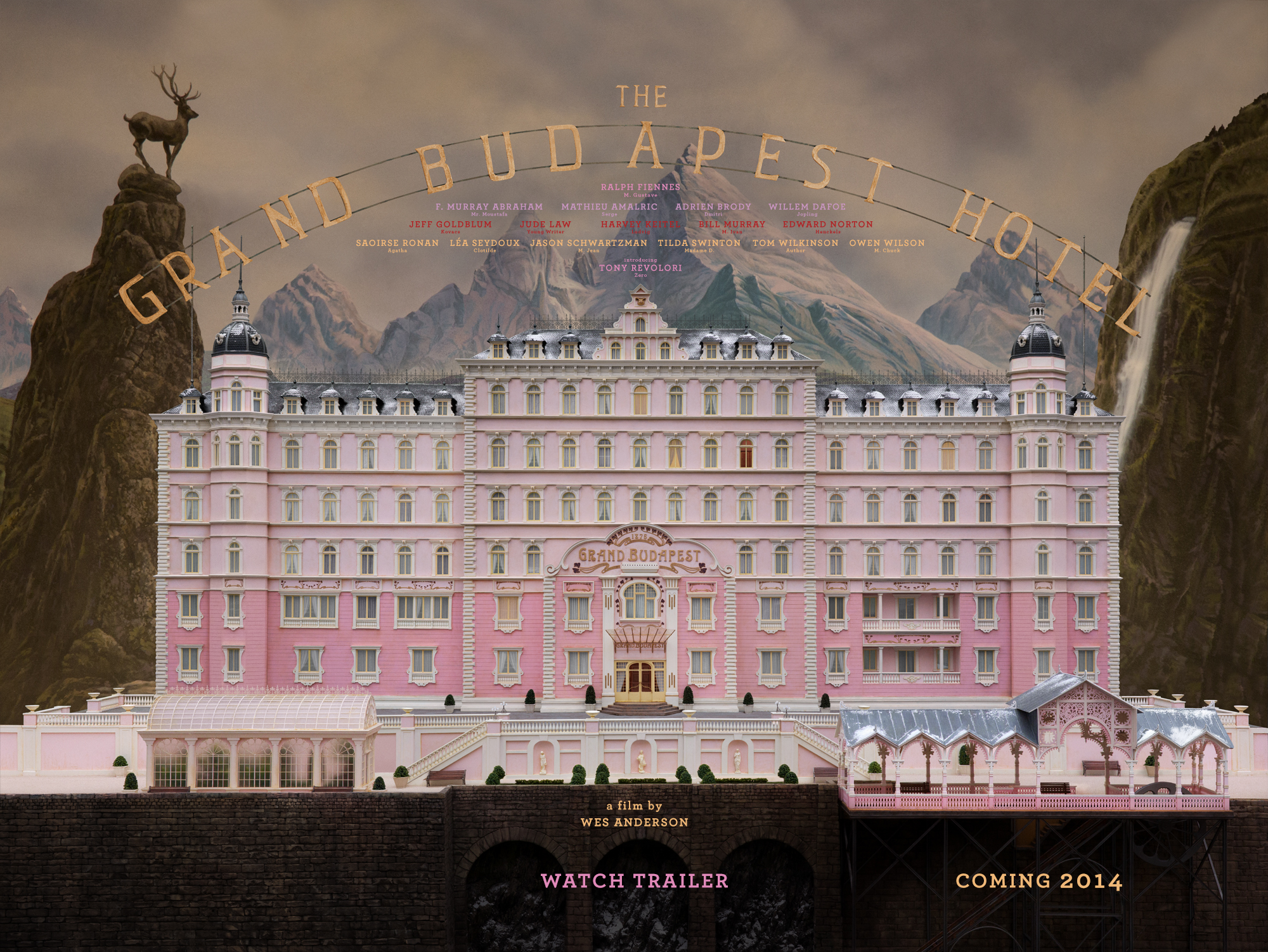
In the review the author explains that there are elements of which every "movie-gower" would enjoy. He prefaces this statement by explaining that Wes Anderson takes the story lightly enough for things to be funny and for things to be serious. Scott believes that the average person does not want to go into a deep and philosophical film. The average person wants to see a movie where they can escape to and let the universe engulf them. Which is exactly what Wes Anderson does in his movie.
The story follows a bell keeper who has to try and clear he name of his boss, who is a concierge. The movie takes place in an alternate universe of pre-World War I Europe. Although the movie does not specify any parts of history it does elude to the horrors of war and the injustices of the government done during these times. However even during this time the director is able to have the audience laugh at these events and, in a way, makes fun of these events.
The authors overall rating is that everyone should go see the movie. He believes that this is a modern work of art which holds a candle to older European films. While some Wes Anderson fans might think it is different they will like it all the same. As for people who have never seen a Wes Anderson film this is a perfect film to see in order to introduce the audience into the world of Wes Anderson.
I believe that the author did a great job of explaining the film and showing the public of a new piece everyone should watch.
Sunday, March 2, 2014
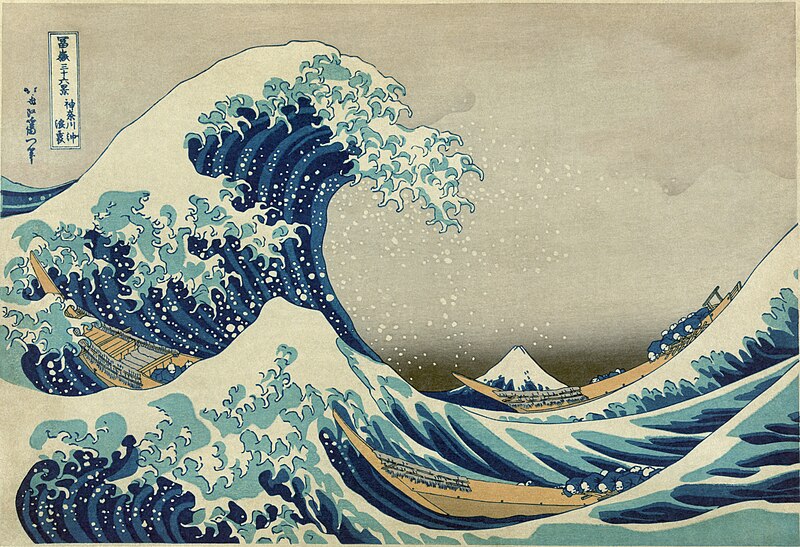
TOW # 20 The Great Wave off Kanagawa By: Katsushika Hokusai
My goals are for this
tow would be to have a strong introduction and to have detailed explanations as
to why I have chosen those points to focus on during the analysis. I would like
my TOW to flow better and for it to have a logical direction and for it not to
be a jumble of words. The TOW should also contain a high level of diction as it
is about on e of the most famous pieces of Japanese art.
The Great Wave off
Kanagawa is one of the most
famous pieces of Japanese art, and also one of the most recognizable pieces of
art. People from all over the world will know this piece. They may not know the
exact name for the piece, but they do now that it is from a Japanese
mastermind. Created by Katsushika Hokusai,
this piece is actually supposed to be along side thirty-six other pieces.
All of the art pieces are wood blocks that were created to show Mount Fuji, a
national icon, to the world. During this time period Japan was under a lot of
stress. They were either going to modernize and try and keep up with the western
world. Or they were going to run the risk of getting invaded by one of the
western powers. This piece was meant to show determination in the face of
adversity and the beauty of Japan.
The Great Wave off
Kanagawa may seem like a giant wave destroying
two fishermen fishing, but this is not the case. The context of the
fishermen is that they are trying to get food to the Kanagawa prefecture where
they would make their money. Katsushika Hokusai
wanted to create these characters in order to show the Japanese people that
they need to grow stronger and learn to adapt and beat back the wave. The
artist did not want his country to fall into the Imperialist nation’s hands; he
wanted Japan to be independent and strong. Mr. Hokusai also creates makes a
sense of national pride by create the backdrop of the scene of Mount Fuji.
Mr.
Hokusai wanted the Japanese people to take pride in their national treasures.
Since the Imperialist nations were going around and taking over countries he
felt that it was important for the Japanese people to be reassured that they
are also a powerful nation. The backdrop to the great wave is a picture of
Mount Fuji. At the time many people who had come to visit Japan believed that
to be one of its many beauties. Playing on this belief Mr. Hokusai used Mount
Fuji to appeal to pathos and fuel the idea of nationalism into the Japanese
people. He wanted the people to strong and ready to defend against Imperialist
powers.
One of the most
recognizable paintings The Great Wave off Kanagawa strikes a chord with many Japanese people.
The piece is both a reminder of how far the Japanese have come. By using an
example of fisherman fighting the great wave in order to provide for their families
to show endurance Hokusai shows the Japanese that they to can fight against the
imperialist nations. Finally using Mount Fuji as a backdrop elucidates to the
people that they have beautiful things in their country and things that are
worth being proud. A piece that transcends time The Great Wave off Kanagawa the
piece will surely be remembered for years to come.
Sunday, February 23, 2014
TOW #19 IRB Forbidden Freedom: The Story of British Guyana By: Cheddi Jagan
In the final parts of this book the author begins to explain the repercussions of the British's actions and what he and his party members must do in order for the newly formed country of Guyana to prosper. The author composed the this piece in order to appeal to the later generation and warn them of the past and of what has happened. The author begins the second half of the book by talking about how he and his party members were kicked out of office. Mr. Jagan makes a remark in one of the chapters of the irony of having the British leave and then come back only to take back full control. After the British take back control they set up their own democratic party and Mr. Jagan arranges his members again in order to go up against this newly formed party. He stated that during the new elections the new party did not win the majority, rather they were given it by another political party that handed the win to the newly formed group. This group was then transformed into the dictatorship of Forbes Burnham. This began after the British felt that their job of destroying the communist threat was over. Mr. Jagan describes the years forward as "fixing a backwards nation." At the end of the book he explains that he is optimistic about the situation and believes that with time the country can heal and prosper as he had once hoped.
The author uses many of personal experiences throughout the book. He explains how the military came to the government building where he was staying at and set him to his house to stay. He uses this example to show how the British stomped on through and disrupted the country entirely. I believe that the author did an excellent job at portraying what happened during his time in Guyanese history.
The author uses many of personal experiences throughout the book. He explains how the military came to the government building where he was staying at and set him to his house to stay. He uses this example to show how the British stomped on through and disrupted the country entirely. I believe that the author did an excellent job at portraying what happened during his time in Guyanese history.
Monday, February 3, 2014
TOW #18 IRB Forbidden Freedom: The Story of British Guyana By: Cheddi Jagan
This book
is an autobiography of the Prime Minister of Guyana when it became independent
from Britain. He was fairly elected to become the Prime Minister of Guyana
however he was taken out of power and had the newly formed constitution
suspended. The old rulers of Guyana, Britain, did all this. The British Prime
Minister, Winston Churchill, believed that the people in Guyana were Communists
and believed that they needed to intervene and stop what was going on. It is
explained in the book that that was the opposite of what was happening. The
British send their military and re-take control over the entire country. After
explaining this predicament the author then goes into the history of Guyana.
Dr. Jagan goes on to explain that Guyana was the only South American territory
that the British had. The British had ruled the country for 150 years and they
had only been using it to extract cotton from the land. During the Great
Depression the Guyanese began to create their own industry and looked in to
creating something new and looked into a new industry. They began working on
sugar and also working on creating unions of their own. After world War II the British began taking measures to let go of this country. They thought that they might not need it because of the globally changing economy as well as the protests for freedom from the Guyanese people. When they Guyanese people were given their freedom they created a constitution and had a democratically elected leader. This all took place in the first five chapters of the book. I believe that this was a good introduction to many of the people who might have not known anything about Guyana. The author did a great job of introducing the author and the main problem of the book.
Sunday, February 2, 2014
TOW # 17 Keeping Super Bowl Lights On: An Extra Line, Generators in Place By : Patrick J. Kiger
Since the Super Bowl is today people remembered the last super bowl and its highlights and its low lights. One of the low lights was that the power went out for 34 minutes delaying the game and causing an uproar everywhere. Now with the Super bowl here the convention team is hard at work to make sure that this does not happen again. This article was published in the National Geographic written by a blogger named Patrick J. Kiger. This article was written in order to assure the masses that measures had been taken out in order to prevent from a situation like that of the last super bowl. The author of this article wanted to assure the masses that they were not going to see that debacle with the lights ever again. The author does this by referencing some of the things that the Super bowl committee has done to fix the power issue. One of the things that the committee did was they added an extra emergency power line to the stadium. In case of one source of power randomly stop working they have a back up source of power that can light up the stadium if need be. There was also a point in the article where the author was able to contact the lead electrician for the stadium. The lead electrician explained to the author that since the game is being played in an open air stadium there will be hardly any chance for there to be an accident because it would mean less lighting to cover and less electricity being used. I believe that the author of this article was able to successfully convey the message that there was nothing to worry about this years Super bowl having a black out.
Tuesday, January 28, 2014
IRB Intro Cheddi Jagan Forbidden Freedom: The Story of British Guyana
First published in 1954 this autobiography of the late leader of Guyana, Cheddi Jagan, recounts the turmoil that his home country faced. During this time period Guyana was beginning to branch out from being a colony of Britain to being a whole other country that could govern themselves. The book goes though the time period where Cheddi Jagan was legally elected but then kicked out of power so that Britain and America could further their anti-communism agenda even though there was no solid bond between Cheddi Jagan and the Communist nations. It also tracks all the time between the oppressive Burnham years and to when Cheddi Jagan was finally elected into power and as able to maintain power without any foreign conflict. The author of this book wants to try and tell his audience what was happening from his point of view so that they understood what he was facing. My great grandfather was a participator in the Cheddi Jagan movement. So in order to learn more about my family and why they left from their home country I am reading this book to clear up some of my preconceived notions. I normally do not read autobiographies unless they are for a project, so this book is a stretch for my library of books.
Friday, January 17, 2014
TOW 16 MLK Day By: Joe Heller
In this cartoon it has a calendar of the month of January. On it has Dr. Martin Luther King Jr. Day written on the January 20th, however on all the other days of the calendar there is an acronym on them stating "MLKD" meaning "Must Live King's Dream." Joe Heller is the artist for this piece. He is an artist who paints for the Green-Bay Press gazette. Dr. Martin Luther King Jr. Day is a day of service. A day where people go out and help their community in any way possible that they can go out and help them. A day where people who do not normally go out and do service can go out do a little bit of service to the people around them. Therefore, when the author puts "MLKD" on the rest of the days of January it is saying that we all need to go out into the community and try and help it everyday of our lives. He is addressing the masses when he created this cartoon. He wanted people who normally do not help their community to get up and go to help people. By creating the cartoon near Dr. Martin Luther King Jr. Day it may cause some people to get up and go out. They might be motivated when they see this cartoon to act and help their community out. I thought that this piece was very effective. It used the idea that we all have to give service once everyday and was able to portray in perfectly by using the calendar and the different acronyms. Having the publication near Dr. Martin Luther King Jr. Day is also very helpful because now I feel as though I need to go out this year and help out my community.

Sunday, January 12, 2014
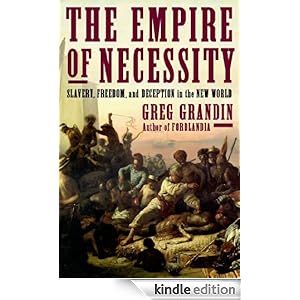
Tow #15 A Vengeful Fury Greg Grandin’s ‘Empire of Necessity’ By: Andrew Delbanco
A powerful new book has been released by Greg Grandin about slavery. In his book he talks about how there were many people who lost their lives to slavery and how it fueled the growth and power of Europe. The author of the book goes into a lot of detail when describing the conditions and what the slaves had to do. Grandin also does a very good job at passing through years of time. The author skips from time period to time period in order to fit the scope of his book. This is detectable and might bother some people. However it is a seamless transition from time period to time period. Another way that the author of the book is able to portray the tragedies of slavery is through short stories that he has found. The author does elaborate on some parts of the history, but he does keep with his theme of the tragedies of slavery. One such story is the one of two New England farmers who would have never been in contact with slaves if it had not been one who ran away telling them of their pains and sorrows as a slave. The author of this review is Andrew Delbanco, the director of American studies in Columbia University. He wrote this review in order for the average person to understand this complex and deep book. He wanted the people who read the New York Times to go and read a book that hey might not have picked up to read. By portraying the book as an intellectually challenging and interesting book the author of this review does accomplish his purpose of getting other people to read this book.
Wednesday, January 1, 2014
TOW #14 Bulbageddon is upon us By: Ry Crist
With the New
Year comes many changes to our daily lives. One of those changes will be the
new standard in energy efficient light bulbs. Ry Crist, the associate editor at
CNET explains that with the addition of a new light bulb to the light bulb
market adds a new energy efficient light bulb. The author explains that with
this new addition to the light bulb market the incandescent light bulb will
become more of a thing of the past. He however states that if you are in
desperate need of an incandescent light bulb shops will still have them because
they will have to try and sell out all of their stock. The author wrote this
piece so he could tell the masses not to worry about their favorite light bulb.
He also wanted them to know that with the end of the incandescent light bulb
will bring on a new age of energy efficiency. By telling a large amount of
people about the changing market of light bulbs there will be a small
percentage of people who will not know why there are less incandescent light bulbs
than there are energy efficient. For people who really want the same
incandescent light the author provides an energy efficient light bulb that will
give off the same amount of light as an incandescent light bulb at a fraction
of the wattage. Ry Crist also explains to the audience that not many people
know if they have incandescent light bulbs or not. He says that 4 out of every
10 Americans do not know if they have incandescent light bulbs or not. By
establishing this point people who read this article will go and check to see
whether or not they have incandescent light bulbs making those people change
their light bulbs or making those people go out and buy incandescent light bulbs. I believe that the article was able to accomplish its purpose of expanding the views of the public on the lightbulb market.

Subscribe to:
Comments (Atom)