Sunday, December 15, 2013
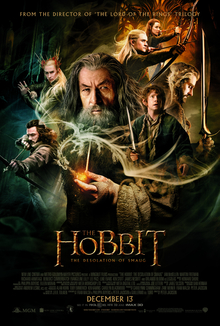
TOW #13 'The Hobbit: The Desolation of Smaug' Review By Mick LaSalle
The latest movie in The Hobbit trilogy has seen critical reviews and many fans have praised the new movie. However there is one movie critic who believes otherwise. Mick LaSalle, a movie critic for the San Francisco Chronicle, believes that the movie is subpar and should not have been made. The Desolation of Smaug is the latest in director Peter Jackson's trilogy from the book The Hobbit, written by J.R.R. Tolkien. The book is a prequel to The Lord of the Rings and follows the story of Bilbo Baggins, the dwarves, and Gandalf the Grey. The author of this review wrote this article for the people who might not know a lot about The Hobbit. He does this by taking generic moments in the movie and analyzing them so that someone who does not know anything about the The Hobbit might get interested in The Lord of the Rings. The author also wants as many people as possible agree with him on how the movie is a complete failure. The author comes off as a fan of The Lord of the Rings but not a fan of The Hobbit. The author has three main points in his analysis of the movie. He believes that the movie falls short, losses balance and does not progress. Mick LaSalle believes that in the movie there are too many things that are emphasized leaving for nothing to be then emphasized. The movie losses balance, he says, by expanding on unnecessary moments in the book. Finally the author argues that this movie does not advance the plot enough from the story to be added into the new The Hobbit series. I believe that the author was able to successfully argue all of his points effectively. I do not agree with some of his points but I understand he may have is opinion.

Sunday, December 8, 2013
TOW #12 War on Christmas By: John Cole
This is a political cartoon created by John Cole that was published in the Scranton Times-Tribune. The political cartoon has a title saying "A Season of Imagination." There are then two children thinking of Santa Claus and a reindeer. Next to them is Bill O'Reilly and Sarah Palin thinking about the anti-holiday people. The author's message in this political cartoon would be to enjoy the holidays and not think about the people who hate the holidays and have fun in your own way. The author is saying that he would rather have the people who are paid to bring up problems, let them do their jobs. While the rest of us have a happy holiday, as though we were a child. The author created this political cartoon for everyone because he wanted them to enjoy the holidays and not worry about the small things. Many people worry over the things that the Bill O'Reilly and Sarah Palin talk about when dome of them do not directly effect any of the people that are listening to them. The author's purpose was to try and tell the people who are reading his political cartoon to not worry about the world and the people who hate Christmas or New Years. The author does not want the people a bunch of angry and unhappy people on Christmas day. A device that the author uses to portray his purpose and convince the audience into not worrying about the small things is the juxtaposition of the two extremes of the holidays. He puts the children next to the extremist politicians creating a sense of silliness in the political cartoon. I believe that the author did a wonderful job at portraying two extremes and still getting an end result.
Friday, November 29, 2013
TOW #11 All Quiet on the Western Front By Erich Maria Remarque
In the
second part of the book the author Erich Maria Remarque is now a seasoned
veteran and has seen death and has now become jaded to it all. The author
is now changing from writing about what is happening in the physical world, but
is now talking about what is going on in his mind. The author explains how he
is slowly losing his mind to the tragedies of war. The author continues write
directly to the public. He wants the idea of how warfare is terrible to be
implanted into the minds of his readers. The author writes all the way until
the end of the war when the armistice was declared in Europe. That is when the
author looks down at his fellow soldiers and does not see the bubbly happiness
one would expect at the end of the war. The author only sees empty shells
crying to come back home. The author also uses an event that occurred to
him in the war to show desperation. During the war there was a town that his
unit had to capture. Inside that town some people had not left the place. So
when his unit when they were shocked to find people still living there. They
let the civilians leave, but some of them did not want to leave. Some of them
had family members who were injured and could not move because of a stray
bullet or projectile. The author explains how a little girl was shot in her leg
and could not move and her family would not leave her. He write that the stood
by her and even though he called for a medic to come and help them, he would
not come help a civilian. They left the town because they were pushed back, and
the fate of the little girl is unknown. I believe that the author did an
excellent job at portraying the psychological problems that come to soldiers
due to war.

Sunday, November 24, 2013
TOW #10 All Quiet on the Western Front By Erich Maria Remarque
All Quiet on the Western Front By Erich Maria Remarque is a very real and sad book about World War I. This book is a re-telling of the events that the author experienced while fighting with the Germans during World War I. The author explains many of the events through a first person view, and with excruciating detail. The author wrote this book for everyone to read. He did not add in any military jargon in his book, it is easily understandable diction. The author wanted everyone to read his book because he wanted them to know the horrors of war. before this point people did not know what the horrors of modern war could bring. With this book printed after World War I it sent waves of anti-war sentiment running through the people. It was unheard of for the time for people to dread war and for it to have been as brutal as described in the book. I only read up to chapter 7, however during the first section of the book it has already established itself as a sad and emotionally taxing book. In the second chapter of the book the author explains the death of one of his comrades when they were sent up to the front lines of the trench. They were bombarded by many of the French machine guns and soldiers. However Remarque's friend was severely injured on his leg. He explains that he had to take his friend to the medical bay and have see his friend get his leg amputated. The description and imagery the author uses in this part in particular is not censored in the slightest. Since the pain of amputation is too much Remarque's friend dies in the hospital bed and then is moved out onto the floor for the next patient to be accommodated. The doctor in this chapter is also not helpful because he brushes off Remarque's plea for the doctor to come over and help his friend. He just says that it is another death of the many that will come during the war. I believe that the author was able to, in the first section clearly describe the problems that he had to face during the war.


Sunday, November 17, 2013
IRB Intro Erich Maria Remarque All Quiet on the Western Front
This book is written by Erich Maria Remarque a solder who fought for the German army during World War I. This book is a narrative of the war from the viewpoint of Erich Maria Remarque. Since he was a soldier in the German army Remarque chose this topic to explain the horrors of war. The author wrote this book after the war when people who had not been in the war can read and understand what war actually means. I wanted to read this book for the longest time but never got around to reading it. I have always hated war and thought it was silly and should never happen. The book is supposed to be a very emotional and raw book and I normally do not read books like that, however I would like to change that with this book.
Sunday, November 10, 2013
Tow #9 Out of Fuel GOEC Satellite to crash land on Earth Sunday Afternoon By: FoxNews
Written by many un-named authors this article goes into detail on the re-entry of a European satellite. The satellite has been in space since 2009 mapping the earth gravitational field. With these images from the satellite scientists have been able to create an interactive image of Earth's gravitational pull allowing other scientists to see the Earth's gravitational pull. The satellite lost fuel around a month ago and is expected to crash land some time on Sunday November 10, 2013. There is no expected crash landing site but European scientists are sure that the satellite should land either off the western coast of Australia or in the uninhabited parts of Australia. The author's also go into detail on whether or not if the satellite were to fall in your backyard. The authors say you could go straight to your government and then have them complain to the scientists who had this accident occur. The authors in this article are writing to a large audience. They achieve this by not using over-complicated words to describe the satellite and instead use words and examples that the average person can understand. The authors wanted to tell as many people as possible because they could get people interested in the world of science. They want people who have never heard of this satellite get interested about it now and see hat it has done during its journey. The authors in this article use quotes from the scientists who are working on the satellite. They do this in order to back up their claim about the satellite falling to Earth. By referencing the people who are working on the satellite it shows that these author's did their research and are credible in this topic. I believe that the authors that worked on this article did an exceptional job in telling the audience about the crash landing of the European satellite.

Monday, November 4, 2013
TOW #8 FYI: Can You Overdose On Halloween Candy? By Shaunacy Ferro
In this article Shaunacy Ferro she was able to clearly explain what happens if someone were to eat only candy for a month straight. The author of the article has written many for Popular Science before and also writes about interesting findings in science on her own blog. The article is created for the masses to read. There are no large medical terms used to describe the state of the subject who is eating only candy for a month. Ferro wants to educate people on this extreme subject. She wants them to understand that the initial idea of eating only candy for a month is crazy, but also makes the reader think about what they eat during the holidays. The author wants the people who are reading this article to become cautious about what they eat this holiday season. Ferro uses jokes in her article to create a light feeling to her subject. At the end of the article she says that she has a back of candy corn in her lap while writing this article. This is stated in order for the article to not be taken too seriously. The author's intention is not for the reader to stop eating candy, or to test out whether or not eating candy for a month would make you sick. The author also uses the example that if one were to eat real black licorice, the one that comes from the root, they would become deathly sick and would actually need to be moved to the hospital to receive actual medical attention. This is used as a reminder to the reader that that even with a silly subject as candy there are real life problems that need to be addressed if one were to eat only candy for a week straight. I believe that the author was able to successfully explain to her audience that eating candy for entire month is a crazy idea that should only be thought about and not put into practice. Through the use of jokes and real life examples the author is able to explain to the reader something they might have never considered.

Sunday, October 27, 2013
TOW#7 "Has Paul McCartney Been Holding Back" By Michael Roffman
On October 15, 2013 Paul McCartney released his 16th
studio album and 24th album since the Beatles “New”. This article
analyzes and looks into the deeper meaning of the songs in Paul McCartney’s
latest album. Written by Michael Hoffman, the author of man of Time Magazines movie and music column
compares the songs on the album to what was going on in McCartney’s life at the
time. The author wrote this piece in order to get the word out to as many
people as possible that Paul McCartney had came out with a new album and it
sounds great. He wanted to reach out to as many people as possible because the
author seems as thought they enjoy Paul McCartney’s work. Hoffman seems to have
enjoyed listening to the new album and wanted other people, young or old, to
enjoy with him. The article is inside of a magazine so it has to be able to
appeal to a wide variety of people. The author makes a reference to Stephen
Colbert in the article in order to make a comparison of the two. The author
wanted to make seem as though the two were alike, two people that were very
important, and in both the new and old generations minds. The author also
references the struggles that Paul McCartney has faced during in his life.
Hoffman talks about McCartney’s divorce and the re-marriage; he uses these
events to relate them to the songs on the new album. The album name song “New”
has a very lighthearted feel and is explaining the happiness and joy Paul
McCartney felt when he re married. The song “Save Us” explains McCartney’s
feelings when he was dating Nancy Shevell. The author also goes into depth on
how well the songs are written and how well they sound. The author exclaims
saying that the songs are fresh and modern, even though Paul McCartney is 71. I
believe that the author did a wonderful job writing and describing the
wonderful new Paul McCartney album “NEW”

Sunday, October 20, 2013
TOW #6 Political cartoon Save the Twinkie Nick Anderson
This political cartoon, drawn by the Houston Chronicle’s
editorial cartoonist Nick Anderson, is making fun of the fight to bring back
Twinkies. The issue that the cartoon has brought up is how there are a lot of
people rallying for the Twinkie to make a come back, and not enough people
fighting to save Earth. The article
shows the mass of people marching around with their “Save The Twinkies” sign
and has two other people off to the side holding a “Save The Earth” and one of
them saying “We’re doomed.” The intended audience for this piece is the general
public. Since it is in a newspaper it has to appeal to all types of people. The
cartoon also has to depict something that is both funny and important for the
reader to look at. The artist wanted to send a message to the readers saying
the we need to not focus on trivial things like the Twinkie and focus on more
important things like saving the Earth. A tool that the artist used when
creating their political cartoon was the juxtaposition of the two groups. The
artist paints the Twinkie group as mad individuals rushing and screaming for
the Twinkie to come back. He depicts them as a large group of different individuals
wide eyed and screaming. Then on the left hand side he depicts the Earth side.
He displays this group as two people who are merely standing there as onlookers
to the chaos of the Twinkie group. I believe that the artist was able to show
their point of view for the issue successfully. The author clearly and
comically displayed the outrageous behavior of those who wanted to have
Twinkies, a mild inconvenience, and those who are fighting to protect the
Earth, a more real threat if not attended to.

Sunday, October 13, 2013
TOW #5 "Blink" Malcolm Gladwell
In the second part of the book Blink, written by Malcolm
Gladwell the author explains the setbacks of quickly judging people as well as how
one can use their ear to judge a piece of music. In the second half of the book
Malcolm Gladwell explains to his audience that even with the ability to look at
a person and almost nearly correctly judge them there are set backs. He uses
the example an event that happened in the Bronx, New York. A man named Diallo
was walking home from a friend’s house in a bad neighborhood in the Bronx. He
had just come to visit, and was now leaving to go home. An undercover police
group sees Diallo standing in the street alone near a door. The three officers,
Boss, Carroll and McMellon, see the man and jump out of their car. At midnight
Diallo sees three large white men walk up to him with firearms holstered in a
bad neighborhood, while the officers see a shady looking man in a bad
neighborhood seeming to go into the house and rob the place. Diallo begins to
run away from the men, the officers chase after him, Diallo reaches for his
wallet hoping to stop the people from chasing him, but the officers sees Diallo
reach for a black object from his pocket and open fire killing an innocent man.
The author is trying to reach to a large group of people in his book and he
uses examples that people would see in the news and analyzes them to fit the
author’s argument. The purpose for writing this book would be to educate the masses
about a contrasting viewpoint that Malcolm Gladwell set up in the beginning of
the book. Mr. Gladwell wants to be seen as an objective author who is merely
presenting facts and analyzing events that pertained to his main idea. I
believe that Malcolm Gladwell is able to effectively establish the idea of how
it can be a good thing to quickly judge a person, and how it is a bad thing to
judge a person. Through the use of everyday examples and careful analyzation
Malcolm Gladwell establish his point on “The Power of Thinking Without Thinking”.

Sunday, October 6, 2013
TOW #4 "Blink" by Malcolm Gladwell
Blink, a book
written by the renowned psychologist Malcolm Gladwell, is about “The power of
Thinking without Thinking.” The book
goes into how when we look at a person for the first time we unconsciously
judge the person. Mr. Gladwell has written many New York Times bestseller books and is renowned for brining the
unknown into the public’s eyes. He writes this book for a large audience.
Malcolm Gladwell wanted this book for the masses to read in order for them to
be educated. His purpose for writing this book would be to inform the reader
about how people unconsciously judge one another. He is not saying this is a
good thing or a bad thing, Malcolm Gladwell is merely explaining the concept in
the book so far. He has used many sources and credible data supporting the fact
that people judge one another. There is one test that Malcolm Gladwell uses to
demonstrate how we associate certain things with different types of people. It
is called the Implicit Association Test (IAT), or a test where the reader has
to look at one column and put what they believe in 20 seconds goes in that
column. The IAT quizzes you on good white people and bad black people. In 20
seconds your subconscious comes out and it can be surprising thing to find out
what your subconscious really thinks. Malcolm Gladwell also references the
Korus fiasco. This was a time when the Getty Museum bought a fake sixth century
Korus piece believed to be real at the time. Many people who examined the piece
thought that it was the “real deal”. However, there were some skeptics that
looked at the piece, and in a blink, knew that it was a fake. After having
bought the piece the museum later found out that the piece was indeed a fake. I
believe that Malcolm Glad well did a great job so far in achieving his purpose.
He has provided tests and stories of how we judge others with out us knowing.

Subscribe to:
Comments (Atom)